Sleep Basics and Practical Web Alarm Settings
Understanding sleep stages and circadian rhythms can help you review your sleep and wake habits. A clock, however, cannot measure your sleep stage or calculate the moment that will feel most refreshing. This guide uses established sleep recommendations and the actual capabilities and limits of Clock-Tani to explain how a web alarm can serve as a supporting tool.
The Basic Structure of Sleep
Sleep includes three non-REM stages (N1, N2, and N3) and REM sleep. N1 is the transition from wakefulness, N2 features patterns such as sleep spindles and K-complexes, N3 is slow-wave sleep, and rapid eye movements and vivid dreams are common in REM. These stages repeat through the night, but their duration and proportion vary between people and nights.
The U.S. National Heart, Lung, and Blood Institute's sleep overview explains this basic structure and how sleep contributes to health. It is too strong to assign each stage a single exclusive function or to say waking from one stage always causes severe sleep inertia.
Ninety Minutes Is a Description, Not a Scheduling Rule
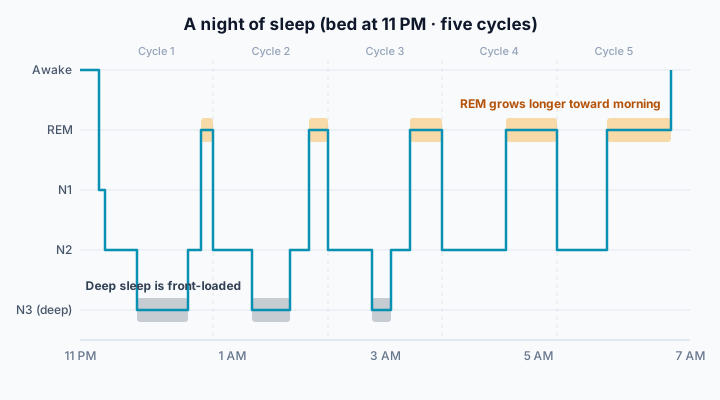
Sleep stages recur in cycles, with more N3 generally occurring earlier in the night and REM periods tending to lengthen later. Cycles are not fixed at exactly 90 minutes, however, and the stages do not always follow one identical sequence or duration. Age, prior sleep loss, alcohol, medication, and health can all affect sleep architecture.
Adding multiples of 90 minutes to a bedtime therefore cannot locate the end of REM or guarantee a refreshed wake-up. The figure below is a simplified illustration of a common direction of change, not a measurement of any individual's sleep.
Circadian Rhythm, Cortisol, and Melatonin
Circadian rhythms influence sleep and wake tendency and many physiological processes on a roughly daily schedule. Light is an important timing cue. Melatonin and cortisol patterns are not tied to one universal clock time; they vary with biological timing, light exposure, schedule, and health. An alarm cannot calculate a cortisol rise that guarantees alertness.
Bright evening light and screen use can affect sleep timing for some people, while morning light is used as a circadian cue. Useful intensity, timing, and duration depend on the situation, so these effects should not be reduced to one fixed number or a universal rule.
Do Not Treat Sleep Loss as a Precise Ledger
Repeatedly getting less sleep than you need can affect attention, reaction, and mood, and long-term sleep deficiency is associated with several health problems. The National Heart, Lung, and Blood Institute's sleep-deprivation guide summarizes symptoms and risks. An individual's impairment cannot be converted reliably into one blood-alcohol value or one percentage change in brain activity.
'Sleep debt' is a useful metaphor, not a ledger in which every missed hour can be added and then subtracted by sleeping the same number of hours on a weekend. Aim for adequate sleep opportunity on a regular basis, and discuss persistent insomnia, severe sleepiness, or impaired functioning with a healthcare professional.
Usage Example: A Wake Log and Backup Alarm
If you repeatedly snooze or feel very different from morning to morning, keep a simple one- or two-week record of wind-down time, estimated sleep and wake time, snooze count, and daytime condition. This is not a test that calculates a personal sleep cycle; it can help reveal patterns such as too little sleep opportunity or a shifting schedule.
The online alarm clock can store up to 10 one-time alarms with different labels and sounds. A web alarm may not run after its page closes or while the device sleeps, so use the operating system's built-in alarm as a backup for an important wake-up. The related alarm-setting guide includes a fuller checklist.
Recommended Sleep Duration by Age
Recommended sleep ranges differ by age. The table below shows the National Sleep Foundation's age-based recommendations, developed by an expert panel.
| Age group | Recommended sleep |
|---|---|
| Newborns (0–3 months) | 14–17 hours |
| Infants (4–11 months) | 12–15 hours |
| Toddlers (1–2 years) | 11–14 hours |
| Preschoolers (3–5 years) | 10–13 hours |
| School-age children (6–13 years) | 9–11 hours |
| Teenagers (14–17 years) | 8–10 hours |
| Adults (18–64 years) | 7–9 hours |
| Older adults (65+) | 7–8 hours |
These are population-level recommendations, not a diagnosis or a prescribed bedtime. Individual needs can vary with health and life circumstances. If you repeatedly cannot obtain an age-appropriate amount of sleep or remain very sleepy despite adequate opportunity, discuss it with a healthcare professional.
Work Backward from the Required Wake Time
The time needed to fall asleep is not the same every night and cannot be known precisely from a clock. Start with the time you must be awake, then work backward to allow an age-appropriate sleep opportunity plus your normal wind-down time. Healthy adults can use the American Academy of Sleep Medicine and Sleep Research Society consensus recommendation of seven or more hours of regular sleep as a reference.
For a 7:00 AM wake-up, allowing at least seven hours actually asleep is more important than trying to hit five 90-minute blocks. If you routinely spend a long time unable to fall asleep or wake often, seek clinical advice rather than repeatedly adjusting an unvalidated formula.
Usage Tip: A Two-Week Sleep Log
A simple log can help you explore relationships between daily habits and how you feel after waking. Record lights-out time, estimated sleep and wake time, nighttime awakenings, naps, caffeine or alcohol, and next-day sleepiness in the same format. Keeping the schedule reasonably stable makes days easier to compare.
This record cannot measure sleep stages or your personal cycle length, and a few high ratings do not establish an optimal cycle. Use it to adjust sleep opportunity or to describe a persistent concern to a healthcare professional. Clock-Tani's online alarm can provide a supporting one-time alert for the wake times you record.
A Practical Alarm Setup Checklist
- Choose the required wake time and account for preparation time.
- Plan a wind-down time that leaves enough opportunity to sleep.
- In Clock-Tani Alarm, assign a clear label and a sound you can hear on the intended device, then preview it.
- Check media volume, tab muting, audio output, and browser notification permission.
- Keep the alarm page open. A wake-lock request can still be released by the operating system.
- Set a built-in operating-system alarm as a backup for anything you cannot miss.
Clock-Tani supports up to 10 one-time alarms with labels, sounds, and vibration settings. It does not support per-alarm volume, weekday repetition, or gradual volume, and stopping a ringing alarm disables it.
Conclusion
Sleep stages and circadian rhythms describe real biology, but a 90-minute calculation or one alarm setup cannot guarantee a good wake-up. Prioritize adequate sleep opportunity and a sustainable schedule, and use Clock-Tani as a one-time supporting alarm while its page stays open. Persistent insomnia or daytime sleepiness calls for healthcare guidance rather than a general web guide.