Exam Time Management Strategies
Time management during exams is often the difference between a good score and a great one. Many test-takers know the material but run out of time, leave questions unanswered, or spend too long on difficult problems while neglecting easier points. This guide covers proven time allocation strategies for major standardized tests, mock exam practice techniques, and mental strategies for performing under time pressure.
The Fundamentals of Exam Time Allocation
Every exam has a time budget, and spending it wisely is a skill that can be practiced and mastered.
The basic formula: Divide total exam time by the number of questions to get your average time per question. For a 60-minute exam with 40 questions, that's 1.5 minutes per question. But this average is a starting point, not a rigid rule.
The 50-30-20 principle: Allocate roughly 50% of your time to answering questions at your natural pace, 30% to working through difficult questions, and 20% as a buffer for review and correction. For a 3-hour exam, that means 90 minutes of steady answering, 54 minutes for hard questions, and 36 minutes for review.
Point-per-minute awareness: Not all questions are worth the same points. Calculate the points-per-minute value of each section. If Section A has 20 points in 30 minutes (0.67 pts/min) and Section B has 40 points in 60 minutes (0.67 pts/min), they're equally efficient. But if Section C has 40 points in 30 minutes (1.33 pts/min), prioritize Section C first.
SAT and ACT Strategies
SAT (Digital, Adaptive Format):
The SAT has two modules: Reading and Writing (64 min total) and Math (70 min total).
- Reading & Writing: ~1.2 minutes per question (54 questions across 2 modules). Read passages once, answer immediately. Flag uncertain questions and return if time permits.
- Math: ~1.6 minutes per question (44 questions across 2 modules). Do straightforward calculations first, then tackle word problems. Use the built-in calculator strategically — mental math is often faster for simple operations.
ACT time management:
- English: 75 questions in 45 min = 36 seconds each. Move fast; trust your first instinct on grammar questions.
- Math: 60 questions in 60 min = 1 minute each. Questions get progressively harder — spend less time on #1–30, save more for #31–60.
- Reading: 40 questions in 35 min = 52 seconds each. Read the passage in 3 minutes, answer questions in 5–6 minutes per passage.
- Science: 40 questions in 35 min = 52 seconds each. Focus on graphs and data — most answers are directly in the figures.
TOEIC and TOEFL Strategies
TOEIC Listening & Reading:
The two timed sections are Listening (45 minutes, 100 questions) and Reading (75 minutes, 100 questions), followed by separate time for biographical questions. See ETS’s official TOEIC Listening & Reading format.
- Listening: Practice answering as the recording progresses. Do not assume a fixed gap between questions; follow the directions and pacing of the official practice audio.
- Reading: Parts 5, 6, and 7 share the 75-minute section. In a timed official practice set, note how long each part took and which items remained. Use those results to adjust your allocation instead of treating any seconds-per-item or Part 7 quota as universal. Leave time to mark your answers.
TOEFL iBT (current format):
The TOEFL iBT changed on January 21, 2026. The former plan of two Reading passages in 35 minutes and a 20-minute integrated Writing task is not a current-format practice plan. ETS’s current test content and structure lists the Reading, Listening, Writing, and Speaking tasks with approximate base times. The test adapts, so item counts and actual test time can vary.
Before a drill, check the ETS instructions for your test date and the time allowed by that official practice exercise. Set Clock-Tani’s timer to the exercise’s stated limit; afterward record completed items, accuracy, and unfinished items. During the real test, follow ETS device rules and the test interface’s clock. Clock-Tani does not replace the official exam timer.
Mock Exam Timer Practice
Practicing under timed conditions is the single most effective way to improve exam time management. Untimed practice builds knowledge; timed practice builds performance.
Progressive timing approach:
- Phase 1 — Generous time (weeks 1–2): Give yourself 1.5x the actual exam time. Focus on accuracy and building familiarity with question types.
- Phase 2 — Standard time (weeks 3–4): Practice under actual exam conditions. Use Clock-Tani's timer set to the exact section durations.
- Phase 3 — Compressed time (weeks 5–6): Practice with 80–90% of the actual time. If you can perform well under compressed time, the real exam will feel comfortable.
Section-by-section practice: Don't always take full practice tests. Isolate weak sections and drill them individually with precise timers. If you consistently run out of time on Reading Comprehension, practice only that section repeatedly.
After each timed practice: Record your completion time, accuracy, and which questions took the longest. Identify patterns — are you slow on specific question types? Do you lose time re-reading passages? Use these insights to adjust your strategy.
A Four-Week Countdown Calendar (D-30 to Exam Day)
The last month before an exam is when timing practice should be scheduled deliberately, not squeezed in around studying. Mapping the progressive phases above onto four weeks looks like this.
| Week | Time condition | Full practice sets | Goal |
|---|---|---|---|
| D-30 to D-22 | Untimed (stopwatch running) | 2 | Measure real time spent per section |
| D-21 to D-15 | 120% of exam time | 2–3 | Get used to working under a clock |
| D-14 to D-8 | 100% — real conditions | 3 | Lock in your checkpoint plan |
| D-7 to D-1 | 90%, then final 2 runs at 100% | 2–3 | Build a speed reserve, then restore real rhythm |
Weekly self-checks:
- Week 1: Did you write down per-section times as numbers, not impressions?
- Week 2: Did you finish within the limit on at least half of your runs?
- Week 3: Are your checkpoints (e.g., question 20 by minute 30) written down before you start?
- Week 4: Do you still reach the final section under the 90% condition?
One warning: don't end your preparation on compressed-time runs. The last two practice sets before exam day should be at 100% — otherwise you walk in with an artificially rushed pace. And remember that this calendar schedules your timing practice, not your studying: reviewing mistakes and shoring up weak areas needs its own separate time.
Maintaining Time Awareness During the Exam
Knowing how to pace yourself theoretically is different from actually doing it under pressure. Here are practical techniques for staying time-aware throughout the exam.
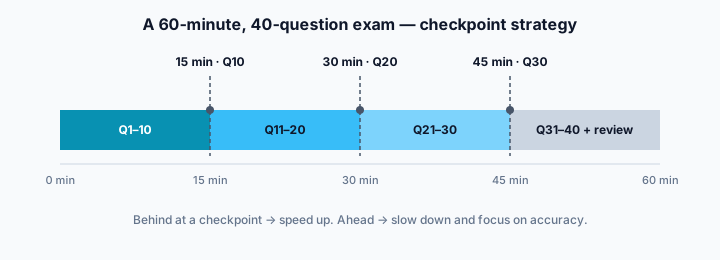
Checkpoint method: Divide the exam into quarters and set mental checkpoints. For a 60-minute, 40-question exam: you should be at question 10 by minute 15, question 20 by minute 30, and question 30 by minute 45. If you're behind at any checkpoint, speed up immediately.
The two-pass strategy:
- First pass: Answer every question you can solve quickly and confidently. Skip anything that takes more than 1.5x the average time per question. Mark skipped questions clearly.
- Second pass: Return to skipped questions with remaining time. You now have context from the entire exam and can make better-informed attempts.
The 2-minute rule: Never spend more than 2 minutes on a single multiple-choice question. If you can't solve it in 2 minutes, make your best guess, mark it, and move on. Two minutes spent on one hard question could have answered three easy ones.
Watch placement: Place an analog watch (if permitted) directly above your paper for glanceable time checks. Digital watches require pressing a button, which breaks focus. Alternatively, practice gauging time without a watch — your internal clock improves with mock exam practice.
Mental Strategies for Time Pressure
Time pressure can make it harder to decide what to do next. A short, repeatable plan may help, but no breathing or visualization routine guarantees a higher score.
Before the exam: Check the official time limits, section order, and rules for skipping or revisiting questions. Choose a simple plan for checking progress and marking answers. If it helps you settle, take a few comfortable breaths; there is no fixed number of seconds that works for everyone.
During the exam: If you find yourself rereading the same question without progress, briefly pause and decide whether to continue or move on. Skip and return only when that exam allows it. Recheck the remaining time and the number of unanswered items rather than assuming a fixed pace will fit every section.
After practice: Use a timed official practice set to note where you slowed down, which answers were wrong, and which questions remained. Adjust one part of your plan for the next attempt. A short pause or practice run does not by itself prevent anxiety or save a predictable amount of time.
Usage Example: Review Time Allocation on Past Papers
First use the stopwatch to measure time by section and identify question types that consume the most time. Then set the Clock-Tani timer to the official exam duration and choose checkpoints, such as the question number to reach halfway through. Record accuracy and unanswered questions as well as speed.
If watching the countdown increases anxiety, keep it out of sight and check only at planned points. Wake Lock merely requests that a supported device remain awake and can be released, so review power settings too. Rules for electronics and watches differ by examination; always follow the organizer's official instructions in the real venue.
Conclusion
Exam time management is a trainable skill, not an innate talent. Master the fundamentals of time allocation, practice under timed conditions using Clock-Tani's timer, and develop mental strategies for handling pressure. With systematic preparation, you'll walk into every exam knowing exactly how to spend each minute for maximum results.